

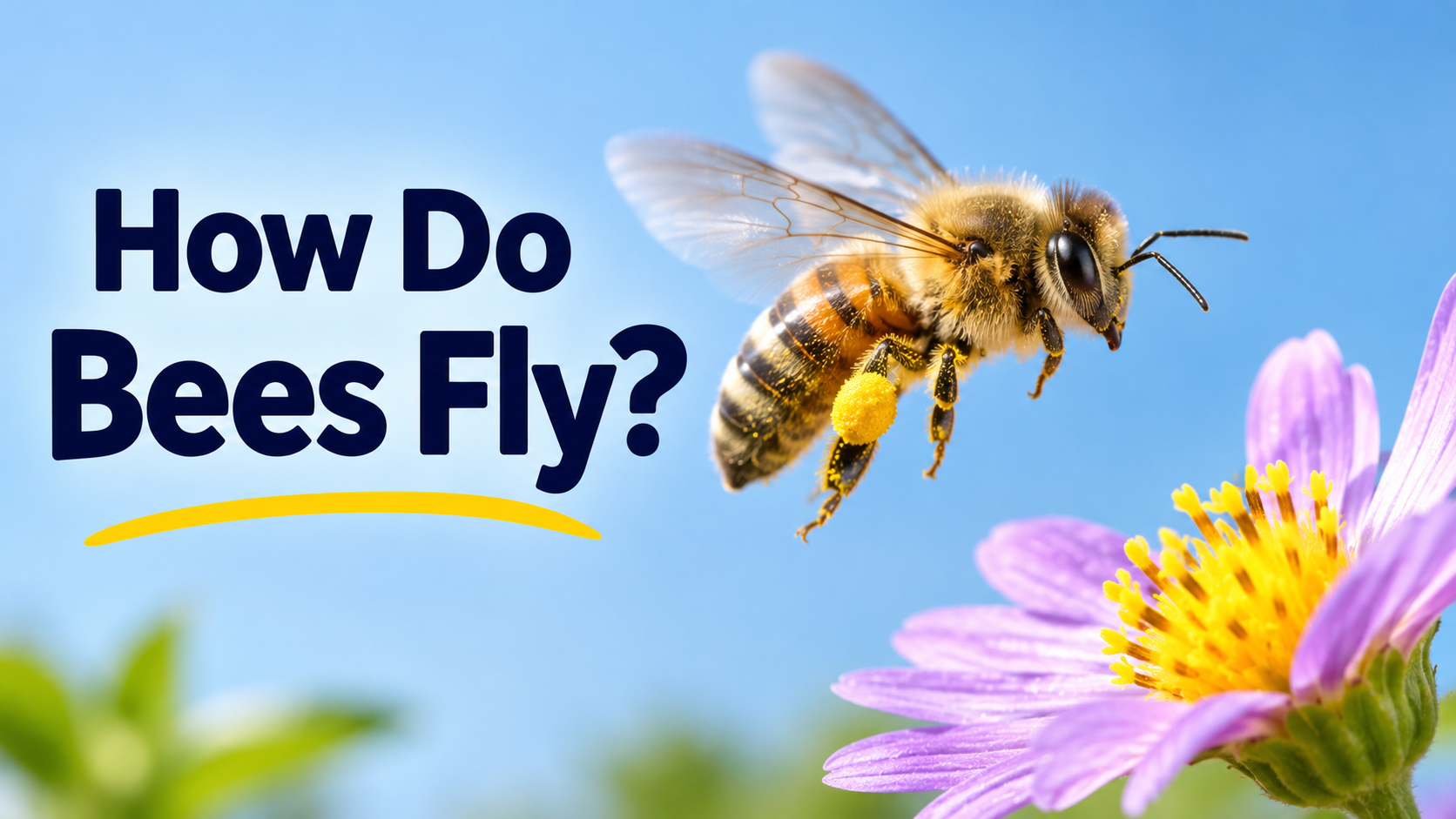
Have you ever wondered how do bees fly despite having such small wings and relatively heavy bodies? Their ability to move through the air has fascinated scientists for decades. An old myth even suggests that bees should not be able to fly according to physics. However, modern research explains exactly how their rapid wing movements generate enough lift to keep them airborne.
How Do Bees Fly With Such Small Wings?
Bees fly by rapidly flapping and rotating their wings, creating aerodynamic forces that support their body weight.
Unlike airplanes, which rely on relatively steady airflow over fixed wings, bees use constantly changing wing movements.
Their wings sweep forward and backward, rotate during each stroke, and generate swirling air currents that contribute to lift.
This combination allows bees to hover, change direction, and travel between flowers.
How Fast Do Bees Flap Their Wings?
Honeybees can flap their wings approximately 230 times per second, according to research conducted at the California Institute of Technology.
These rapid movements produce the familiar buzzing sound people hear when bees approach flowers.
Interestingly, bees do not always increase their wingbeat frequency when carrying heavier loads.
Instead, honeybees can increase the distance their wings travel during each stroke to generate additional aerodynamic force.
This adjustment helps them transport nectar and pollen back to their colonies.
The Science Behind Bee Flight
The secret behind bee flight involves a process known as unsteady aerodynamics.
As a bee moves its wings, air flows around them and forms small swirling structures called vortices.
One important structure is the leading-edge vortex, which can increase the lifting force produced by a moving wing.
Honeybees also generate significant aerodynamic forces when reversing the direction of their wing strokes.
Together, these mechanisms explain how relatively small wings can support a bee’s body.
Why Do People Say Bees Cannot Fly?
The belief that bees cannot fly originated from early aerodynamic calculations that treated insect wings like airplane wings.
Those calculations failed to account for the complex movements of flexible, rapidly flapping wings.
Modern high-speed cameras and computer simulations have revealed how insects actually produce lift.
Bees do not break the laws of physics. Their flight simply uses aerodynamic mechanisms different from those of conventional aircraft.
How Do Bee Muscles Help Them Fly?
Bees have specialized flight muscles inside their thorax, the middle section of their body.
These muscles create rapid movements that power the wings.
Rather than moving each wing like a human moves an arm, bees use changes in the shape of their thorax to drive wing motion.
This specialized system supports the extremely fast wingbeats needed for flight.
Can Bees Hover in One Place?
Yes, bees can hover while collecting nectar or approaching flowers.
By carefully controlling their wing movements, they generate enough upward force to remain nearly stationary.
They can also adjust their body position and wing movements to steer through the air.
Final Thoughts
Understanding how do bees fly reveals the remarkable relationship between biology and physics.
Their fast wingbeats, specialized muscles, and sophisticated aerodynamic movements make flight possible despite their small wings.
Scientists continue studying these abilities to improve knowledge of insect movement and develop tiny flying robots inspired by nature.
